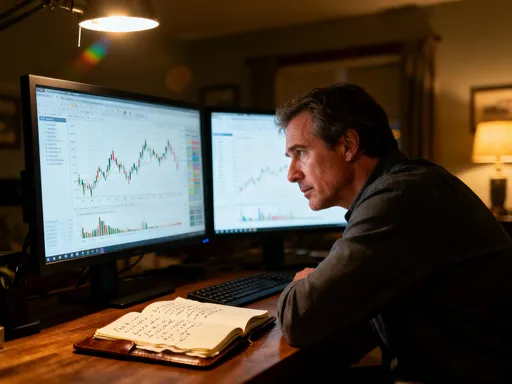
How I Built a Silent Income Machine Through Smarter Fund Management
What if your money could work harder while you sleep? I used to think passive income was just for Wall Street insiders—until I tested real fund strategies that actually deliver. It’s not about luck or secret tricks; it’s about structure, patience, and smart allocation. In this piece, I’ll walk you through how disciplined fund management transformed my finances, cut risk, and created lasting income—no hype, just what works. This isn’t a get-rich-quick story. It’s the quiet, consistent approach that builds wealth over time, protects against downturns, and delivers reliable returns without constant monitoring. The foundation? A well-structured, thoughtfully managed fund portfolio that works like a machine, not magic.
The Myth of "Set and Forget" Passive Income
Many people believe passive income means setting up an investment and never touching it again. This idea is comforting—who wouldn’t want to earn money without lifting a finger? But the reality is far more nuanced. True passive income doesn’t come from ignoring your investments; it comes from building a system so well-designed that it requires minimal intervention, not zero attention. The danger lies in mistaking inaction for strategy. Investors who blindly buy high-yield funds and assume they can forget about them often discover too late that their portfolios were quietly losing value.
Consider the case of high-dividend exchange-traded funds (ETFs) that gained popularity during low-interest-rate environments. Many investors flocked to these products, lured by yields that seemed too good to pass up. But when interest rates began to rise and market volatility returned, some of these funds experienced sharp drawdowns. Why? Because they were heavily concentrated in sectors like utilities or real estate investment trusts (REITs), which are sensitive to rate changes. Those who didn’t understand the underlying structure of their funds were caught off guard. The lesson is clear: passive does not mean uninformed. A fund that promises high income today may carry hidden risks that only become visible when markets shift.
The illusion of safety in passive investing often stems from branding. Financial firms market certain funds as “low-risk income generators,” but marketing materials rarely highlight turnover ratios, expense loads, or sector concentration. Without digging deeper, investors may assume they’re protected when they’re actually exposed. For example, a fund that advertises a 6% yield might achieve that by holding speculative bonds or using leverage—strategies that amplify returns in good times but magnify losses in bad ones. This is why understanding what a fund actually owns, how it generates returns, and what fees it charges is essential. True passivity only works when built on proactive research and ongoing oversight.
Another common pitfall is the belief that diversification alone eliminates risk. While spreading investments across multiple funds reduces exposure to any single asset, it doesn’t protect against systemic risks if all holdings react similarly to market stress. During the 2022 market correction, for instance, many so-called diversified income funds declined together because they shared overlapping holdings in technology and growth equities. Investors who thought they were protected by diversification learned that correlation matters as much as variety. This reinforces the need for active monitoring, even in a passive strategy. The goal isn’t to trade frequently, but to ensure the portfolio remains aligned with its original risk parameters.
Why Fund Structure Determines Long-Term Gains
Not all funds are created equal, even if they appear to serve the same purpose. Two funds with identical names and similar stated objectives can deliver vastly different results over time. The difference lies in their internal structure—the mechanics that determine how they operate, what they cost, and how they behave under pressure. Understanding these structural elements is critical for anyone seeking sustainable income. The most important factors include expense ratios, turnover rates, asset quality, and transparency in holdings.
Expense ratios may seem small, but their impact compounds over time. A fund charging 1.2% annually might not appear much more expensive than one charging 0.4%, but over a decade, that difference can erode thousands of dollars in potential gains. Imagine two investors, each starting with $100,000 in a fund returning 6% annually. After 10 years, the investor in the lower-cost fund would have over $15,000 more, simply due to lower fees. This isn’t speculation—it’s basic math. High fees don’t guarantee better performance; in fact, studies have shown that lower-cost funds often outperform their more expensive counterparts over the long term. The takeaway is simple: always compare expense ratios when evaluating funds.
Turnover rate is another silent factor that affects returns. This measures how frequently a fund buys and sells its holdings. A high turnover rate means more trading activity, which leads to higher transaction costs and potentially larger tax bills for investors in taxable accounts. Funds with excessive turnover often chase short-term trends rather than focusing on long-term value. In contrast, funds with low turnover tend to hold quality assets for longer periods, benefiting from compounding and reduced frictional costs. When reviewing a fund, it’s wise to check its turnover rate—ideally below 30% for equity funds and even lower for bond funds.
Equally important is the quality of the underlying assets. A fund may claim to invest in “blue-chip” companies, but what does that actually mean? Some funds include companies with weak balance sheets or declining earnings just because they have household names. Others maintain strict criteria for profitability, cash flow, and dividend sustainability. This is where transparency becomes non-negotiable. Funds that publish their full holdings monthly or quarterly allow investors to see exactly what they own. Those that only disclose holdings twice a year or use vague categories make it difficult to assess true risk. I personally avoid any fund that lacks clear, timely reporting of its portfolio.
One practical way to compare funds is through side-by-side analysis. Look at two funds in the same category—say, dividend growth ETFs. Compare their expense ratios, turnover rates, top holdings, and performance during previous market downturns. You’ll likely find meaningful differences. One might have a lower fee and more stable holdings, while the other relies on speculative sectors to boost yield. The better choice isn’t always the one with the highest return last year. It’s the one built to last, with a structure designed for resilience and efficiency. Structure isn’t glamorous, but it’s what separates enduring success from short-lived gains.
Building a Multi-Layered Income Portfolio
Passive income isn’t the result of a single winning investment. It comes from a system—a portfolio designed with intention, where each component plays a specific role. I learned this the hard way after years of chasing high-yield funds without a clear strategy. My breakthrough came when I shifted from picking individual winners to designing a layered approach. This method divides the portfolio into three distinct layers: stability, growth, and hedge. Each layer serves a purpose, balancing income generation with capital preservation and risk mitigation.
The first layer, stability, forms the foundation. It consists of low-volatility funds that provide consistent, predictable income with minimal risk. These include short-to-intermediate term bond funds, Treasury Inflation-Protected Securities (TIPS), and high-quality municipal bond funds. The goal here isn’t high returns but reliability. These assets act as ballast during market turbulence, helping to smooth out portfolio swings. I allocate about 40% of my income portfolio to this layer, ensuring that even in a downturn, a significant portion of my holdings remains stable.
The second layer, growth, focuses on long-term capital appreciation and rising income. This includes dividend-paying equity funds, particularly those that target companies with a history of increasing payouts. I favor funds that invest in large-cap, financially healthy firms across sectors like consumer staples, healthcare, and industrial goods. These companies tend to weather recessions better and continue paying dividends even when markets struggle. While more volatile than bonds, these funds offer the potential for both income and price appreciation. I allocate roughly 35% of my portfolio to this layer, rebalancing annually to maintain target weights.
The third layer, hedge, protects against unexpected risks. It includes real asset funds such as those investing in infrastructure, energy pipelines, and real estate. These assets often have pricing power and generate income through leases, tolls, or royalties. Because they behave differently from stocks and bonds, they provide diversification benefits when traditional markets decline. I also include a small allocation to gold and commodities funds as a further hedge against inflation and currency devaluation. This layer makes up about 25% of my portfolio and is reviewed semi-annually to ensure it remains aligned with macroeconomic trends.
Rebalancing is key to maintaining this structure. Without it, one layer can grow disproportionately, shifting the portfolio’s risk profile. For example, if equities perform well, the growth layer might expand from 35% to 50%, exposing the portfolio to more volatility than intended. I rebalance once a year, selling overweight assets and buying underweight ones to restore balance. This discipline forces me to sell high and buy low, reinforcing the compounding effect. Behavioral consistency matters as much as the strategy itself—emotional reactions to market moves can derail even the best-designed plan.
Risk Control: The Hidden Engine of Sustainable Returns
Many investors focus on returns, but the real key to long-term success is risk control. High returns mean nothing if they come with the risk of permanent loss. The goal of fund management isn’t to maximize gains in good years—it’s to minimize damage in bad ones. This is where disciplined risk management becomes the hidden engine of sustainable income. Two critical tools in this process are drawdown control and correlation analysis.
Drawdown refers to the peak-to-trough decline in a fund’s value. A fund that loses 50% must gain 100% just to recover. That’s why limiting drawdowns is crucial. I evaluate every fund not just by its returns, but by how it performs during market stress. A fund that drops less than the broader market in a correction is doing its job. I look for funds with strong risk-adjusted returns, measured by metrics like the Sharpe ratio, which accounts for volatility. A higher Sharpe ratio means better returns per unit of risk. This helps identify funds that deliver performance without excessive swings.
Correlation analysis is equally important. If all the funds in a portfolio move in the same direction at the same time, true diversification doesn’t exist. I use correlation matrices to assess how my funds interact. Ideally, I want low or negative correlations between layers—for example, when equities fall, bonds or real assets might hold steady or even rise. This reduces overall portfolio volatility and improves resilience. During the 2020 market shock, portfolios with low-correlation assets recovered faster because losses were contained in specific areas rather than spreading across the board.
Liquidity is another often-overlooked aspect of risk control. A fund may promise high yields, but if it holds illiquid assets, it could face redemption pressure during downturns. Some bond funds, for instance, invest in high-yield corporate debt that becomes hard to sell when markets freeze. This can lead to forced sales at depressed prices, hurting all investors. I prioritize funds with strong liquidity profiles—those that hold easily tradable securities and maintain cash buffers to meet redemptions. This ensures that even in stress periods, the fund can operate smoothly without penalizing shareholders.
Early warning signs are also part of my risk management routine. I monitor fund behavior for changes in strategy, such as sudden shifts in sector allocation or increased leverage. A fund that starts taking on more risk than advertised may be chasing returns, which increases vulnerability. Similarly, a spike in tracking error—the difference between a fund’s performance and its benchmark—can signal trouble. These indicators don’t always mean immediate action, but they prompt deeper investigation. Catching issues early allows for timely adjustments before losses accumulate.
The Rebalancing Ritual That Keeps Compounding Alive
Most investors set their asset allocation once and never revisit it. They assume that if a fund performed well last year, it will continue to do so. But markets change, and so do fund behaviors. Without regular rebalancing, a portfolio can drift far from its intended risk level. I treat rebalancing as a ritual—a disciplined practice that keeps compounding alive and risk in check. It’s not about timing the market; it’s about maintaining discipline.
My process is simple but effective. Once a year, I review my portfolio’s current allocation against my target weights. If any layer is more than 5% above or below its target, I make adjustments. This usually means selling some of the outperforming assets and buying more of the underperforming ones. At first, this feels counterintuitive—why sell what’s working? But over time, I’ve seen how this practice locks in gains and resets risk. More importantly, it enforces a buy-low, sell-high mentality that most investors struggle to follow emotionally.
Tax efficiency is a consideration, especially in taxable accounts. I prioritize rebalancing within tax-advantaged accounts like IRAs first, where trades don’t trigger capital gains. When adjustments are needed in taxable accounts, I look for opportunities to offset gains with losses, a strategy known as tax-loss harvesting. This reduces the tax burden while maintaining strategic alignment. I also avoid frequent trading, which can erode returns through commissions and slippage. Annual rebalancing strikes the right balance between responsiveness and restraint.
The psychological challenge of rebalancing is real. It requires resisting the urge to chase performance and accepting that short-term underperformance is part of the process. I keep a journal of each rebalancing decision, noting the rationale and market conditions. This helps me stay objective and avoid emotional drift. Over full market cycles, disciplined rebalancing has consistently outperformed static portfolios. It doesn’t make headlines, but it builds wealth quietly and reliably.
Tools and Habits of Advanced Fund Managers
Success in fund management isn’t just about picking the right funds—it’s about how you monitor them. I use a combination of tools and habits to maintain oversight without overcomplicating the process. These aren’t exotic systems, but practical methods that keep me informed and in control.
First, I rely on a screening dashboard that tracks key metrics for each fund: expense ratio, turnover rate, yield, Sharpe ratio, and year-to-date performance. This allows me to spot outliers quickly. For example, if a fund’s expense ratio suddenly increases, it could indicate a change in management or strategy. If its Sharpe ratio declines, it might be taking on more risk for less return. The dashboard serves as an early-alert system, prompting deeper review when needed.
Second, I review performance attribution reports annually. These show not just how a fund performed, but why. Did it outperform because of sector bets, stock selection, or market timing? Understanding the drivers helps me assess whether the fund is sticking to its mandate or drifting into speculative territory. I avoid funds that rely on luck rather than skill.
Third, I maintain a monthly review rhythm. Every four weeks, I check fund news, manager commentary, and any changes in holdings. I don’t react to every headline, but I stay informed. I also avoid financial media noise, which often amplifies fear or greed. Instead, I focus on facts: what the fund owns, how it’s managed, and whether it still fits my strategy.
Journaling is another habit that keeps me grounded. I record major decisions, market observations, and emotional reactions. Over time, this reveals patterns in my thinking and helps me refine my approach. These tools and habits don’t require hours of work—just consistency. They turn fund management from a reactive chore into a proactive practice.
From Income to Independence: Scaling Beyond the Basics
Once the system is in place and running smoothly, the real transformation begins. It’s no longer just about money—it’s about freedom. Predictable income from well-managed funds changes your relationship with work, time, and choices. You stop trading hours for survival and start designing a life based on values, not necessity. This is the ultimate win: not just financial independence, but mental clarity and peace of mind.
I remember the first time I realized my portfolio was generating enough income to cover essential expenses. It wasn’t a huge amount, but it was reliable. That shift changed everything. I no longer feared job loss the way I once did. I could make career decisions based on fulfillment, not just paycheck size. I had the space to pursue interests, spend time with family, and focus on health without financial panic. This isn’t about quitting work entirely—many people continue working because they enjoy it. It’s about having the choice.
Fund management, when done right, becomes more than a financial tool. It becomes a framework for living with intention. The discipline of structuring, monitoring, and rebalancing teaches patience, long-term thinking, and emotional control—skills that extend far beyond investing. It reinforces that lasting results come from consistency, not shortcuts.
Passive income isn’t magic. It’s method, maintained. It rewards those who build wisely, monitor diligently, and stay the course. For anyone seeking financial stability and freedom, the path isn’t found in speculation or hype. It’s found in the quiet, consistent work of smarter fund management—a silent income machine that runs on discipline, not luck.